

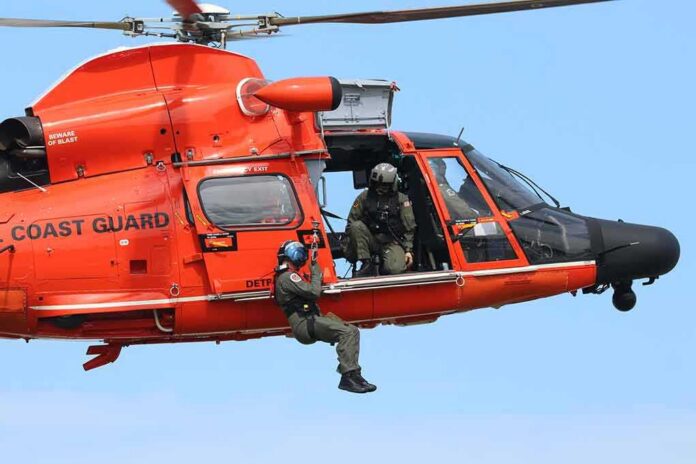
Two people died, two were hospitalized, and one person is still missing after a medevac helicopter plunged into the Pacific moments after leaving Catalina Island.
Story Snapshot
- Officials say a medical helicopter with five aboard crashed near Avalon around 8 p.m.
- Two people died at the scene; two survivors were taken to Los Angeles hospitals.
- One person remains missing as a multi-agency search continues through night seas.
- REACH Air Medical Services confirmed one of its helicopters was involved.
Rescue launched within minutes as calls reported aircraft down
Los Angeles County emergency crews rushed to the waters off Avalon just before 8 p.m. after reports of a downed helicopter. Dispatchers recorded the first alerts around 7:50 to 7:53 p.m., which aligns across several outlets covering the response window. County fire officials said two people were declared dead at the scene. Crews pulled additional occupants from the water and moved two survivors to mainland hospitals. One person remained unaccounted for as boats and air assets pushed the search past midnight.
Los Angeles County Supervisor Janice Hahn said the helicopter had just departed Catalina on a medical mission when it crashed. She cited an all-hands response by Los Angeles County Fire, the Sheriff’s Department, the United States Coast Guard, and Avalon Fire, signaling a large, coordinated operation spanning island and mainland resources. That joint posture matters in open water. Each minute costs body heat and strength, and the window for a live recovery narrows fast when night and swell combine.
Five aboard confirmed; REACH acknowledges involvement
Officials and multiple reports stated the helicopter carried five people. That count shaped the rescue tactics and the headcount that followed when survivors reached shore. REACH Air Medical Services confirmed that one of its aircraft was involved and said its first concern was the well-being of the crew and all aboard. That statement tracks with standard practice for medical flight operators after an accident: acknowledge the event, center the people, and defer cause until investigators build the record.
Reporters at the shoreline and on the island described a tight scene as first responders staged for triage and transport. Two survivors went to Los Angeles County hospitals, with some outlets reporting stable condition while others said status was not yet clear at intake. Such gaps reflect timing, not doubt. Early medical details often change as hospitals run scans, stabilize patients, and notify families.
Why air-medical flights crash more often than they should
Medical helicopters fly a small fraction of total helicopter hours yet appear too often in fatal crash logs. Federal Aviation Administration research has tied these events to the same brutal mix that challenges any night rotorcraft crew: darkness, marginal coastal weather, pressure to launch, and complex terrain or water overflight near mountains and shorelines. In plain terms, the mission bakes in risk before the skids leave the pad. That does not assign blame here. It does explain why island-to-mainland legs demand flawless basics and conservative calls.
Past investigations show how one weak link can snap the chain. Investigators have cited fog and low altitude planning errors, rushed preflight checks, and night departures from tight landing zones in prior fatal air-medical crashes. They have also documented events where mechanical issues or sudden pilot impairment turned routine climbs into seconds-long emergencies. The Catalina profile sits in this known risk envelope: night departure, water crossing, coastal winds, and the unforgiving physics of losing power or control at low altitude.
What we know, what matters next for families and crews
Authorities confirmed two fatalities, two hospitalizations, and one person still missing as of the latest updates. The crash happened shortly after takeoff from Catalina Island, near Avalon, between 7:50 and 8:00 p.m. The response drew Los Angeles County Fire, Los Angeles County Sheriff’s Department, the United States Coast Guard, and Avalon Fire. REACH Air Medical Services acknowledged one of its aircraft was involved. Those are the stable facts that shape the next steps for investigators and loved ones.
#BREAKING Medical Helicopter Crash.
Two people have died and two others were injured another is missing after a REACH Air Medical Service helicopter crashed in the waters just seconds after taking off from Pebbly Heliport on Catalina Island.
There is a search for the missing… pic.twitter.com/zeFCD3AsAe
— Tony Perez (@Tony_MNNews) October 1, 2026
Investigators will establish the flight plan, crew roles, and aircraft condition. They will pull radio traffic, dispatch logs, and survivor statements. They will map debris and model altitude and speed from any tracking data. Families will want names, timelines, and a clear account of what happened and why. The public interest is simple and conservative at heart: tell the truth fast, learn the lessons, and fix what can be fixed so the next patient and crew get home.
Sources:
latimes.com, ktla.com, abc7.com, data.ntsb.gov, ntsb.gov
© standardheadlines.com 2026. All rights reserved.