
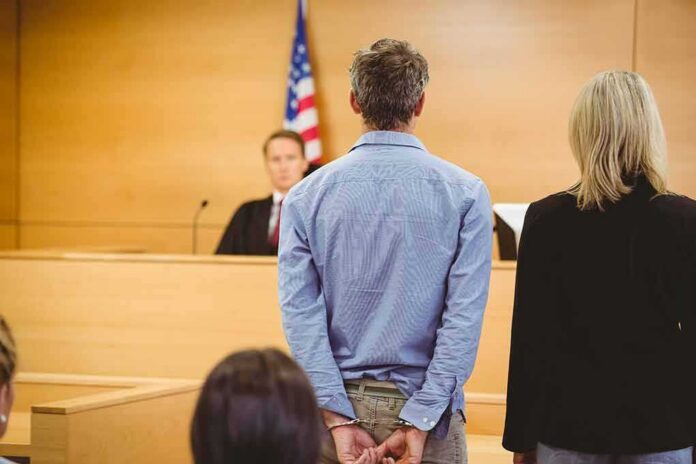
A grieving father-in-law jumped the defense table and punched his son-in-law’s convicted killer during a Phoenix sentencing hearing captured on courtroom video.
Story Snapshot
- Court video shows Alberto Ontiveros-Sanchez striking convicted killer Abel Uribe during sentencing.
- Uribe had pleaded guilty to first-degree murder and received life in prison.
- Police took Ontiveros-Sanchez into custody; charges were later filed, and a judge released him on his own recognizance.
- The outburst followed an emotional victim impact statement, a common flashpoint at sentencings.
What Happened Inside the Phoenix Courtroom
Reports say Alberto Ontiveros-Sanchez finished a victim impact statement, then moved from the lectern toward the defense table and attacked Abel Uribe. Video cited by outlets shows him lunge and swing several times at Uribe’s head while Uribe sat restrained in handcuffs and leg chains. Deputies and others rushed in and pulled Ontiveros-Sanchez away. The hearing took place in a courtroom at the South Court Tower in downtown Phoenix during the late morning hours.
Police took Ontiveros-Sanchez into custody soon after the punches. Outlets report prosecutors later filed counts that included aggravated assault of a bound or restrained victim and interfering with a judicial proceeding. A judge then released him on his own recognizance after an initial appearance, according to consistent accounts across several reports. No official docket or complaint was posted in the reviewed materials, so exact statute numbers were not available.
The Murder Case and Sentencing Context
Abel Uribe had pleaded guilty to first-degree murder for the 2022 killing of 27-year-old David Navidad-Parra, who was Ontiveros-Sanchez’s son-in-law. The court sentenced Uribe to life in prison at the same hearing where the attack occurred. Multiple outlets identify Navidad-Parra as a West Point graduate and Army veteran, and describe the family’s deep grief as they addressed the court before the sentence was imposed. These facts provide the immediate backdrop to the outburst.
Victim impact statements allow families to tell the court how a crime harmed them. The United States Department of Justice explains that such statements can be written or spoken and can describe emotional, physical, and financial impacts. Research shows these statements can shape how people see a case, though their effect on sentence length is mixed across studies. The chance to speak openly in court can also raise emotions, which sometimes leads to disruptions during sentencings.
Why This Moment Resonates Across Politics
This scene hit a nerve because it blends grief, justice, and order in a single tense moment. Many Americans doubt the system serves victims well, and many also worry that courts cannot keep people safe inside their own walls. Here, court officers moved fast, the judge imposed life in prison on the killer, and police still charged the grieving father-in-law for the assault, showing the rules apply even when emotions run high.
CHAOS IN COURT: A grieving Arizona father-in-law lunged across a Phoenix courtroom to attack the man convicted of murdering his son-in-law, 27-year-old Army veteran David Navidad-Parra.
The outburst happened right after his victim impact statement, when he saw the killer… pic.twitter.com/LFLquYI4ZU
— Diamond and Silk® (@DiamondandSilk) September 25, 2026
For families, the sentence locked in accountability for murder. For the court, the attack tested its promise of safety and process. For the public, the video again raised a hard truth: pain does not pause for protocol. The justice system asks victims to speak, but also to hold their anger in check. That is a heavy ask. Clear courtroom security, steady communication by judges, and support for victims can help keep these high-stress moments from boiling over.
Sources:
nypost.com, wcjb.com, youtube.com, us.headtopics.com, fox10phoenix.com, msn.com, yahoo.com
© standardheadlines.com 2026. All rights reserved.