
Celebrity cameos at campaign rallies are not side shows; they are part of the rally’s core machinery, shaping energy, sequencing, and message. Ted Nugent’s appearance before President Trump at the Heartland Credit Union Arena in Kansas illustrates how a familiar cultural figure can be used as a mobilizer—less a concert act than a live-wire surrogate whose language, biography, and cadence warm up a political crowd for the headliner.
At a Glance
- Ted Nugent addressed the crowd before President Trump at an October 19, 2026 rally near Wichita, delivering a combative, values-centric speech captured on local broadcast video.
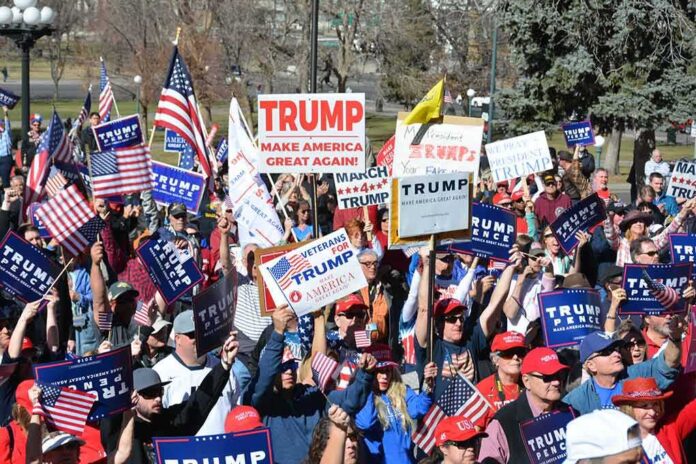
- Local and state outlets documented Nugent as a featured speaker ahead of Trump, with attendance approaching the arena’s capacity based on contemporaneous estimates.
- Nugent framed himself as an “extremist” for God, family, country, and constitutional rights, providing red-meat mobilization rather than policy detail.
- The “opened for Trump” label reflects rally genre and sequencing more than a formal musical billing; what mattered operationally was Nugent’s role as energy and identity amplifier.
What Happened: Nugent before Trump, on camera and on message
On October 19, 2026, rock musician and hunting advocate Ted Nugent took the stage ahead of President Trump at a campaign rally for Senator Roger Marshall at the Heartland Credit Union Arena outside Wichita. Local television recorded Nugent addressing the arena, placing him in the final run-up to the president’s appearance and confirming his role as a featured warm-up speaker. Footage shows Nugent working the crowd with a familiar mix of patriotic invocation, gun-rights rhetoric, and exhortations to turn out like-minded voters.
Regional coverage matches the video record: KMUW’s on-the-ground reporting listed Nugent among the pre-Trump speakers and pegged attendance near 6,000, while Kansas Press described him explicitly as speaking before Trump in a program crowded with Kansas Republican officials. The Wichita Eagle previewed Nugent’s scheduled appearance earlier in the day; later images and video of him in the arena aligned with that schedule. Taken together, the sources establish that Nugent was on the bill and on the microphone shortly before President Trump took the stage.
How rallies use celebrity surrogates: sequencing, mood, and identity
Campaign rallies are not linear speeches; they are choreographed experiences with a genre of their own—opening speakers, ritual acknowledgments, symbolic cues, the headliner’s entrance, and crowd-participation beats like music stings and chants. Within that genre, a celebrity presence has a defined operational purpose. A known figure can collapse warm-up time: the crowd pays attention faster, energy climbs earlier, and the candidate steps into a room already at operating temperature. That is what Nugent delivered in Kansas—an identity-forward, high-velocity speech calibrated for mobilization rather than persuasion, hitting themes (God, Constitution, law and order, self-defense) that previewed the candidate’s message while allowing Trump to reserve his own material for the close.
This is why labels such as “opened for Trump” and “spoke before Trump” circulate interchangeably. They describe the same sequence—Nugent on stage before the headliner—but imply different formalities. Local outlets, which typically stick to event roles rather than show-business billing, called him a speaker; partisan outlets adopted the more theatrical “opener.” In practice, both point to the same production logic: Nugent was deployed to elevate attention and emotion before Trump’s entrance.
What Nugent actually said: values, grievance, and turnout
The content of Nugent’s remarks followed his long-standing public persona—pugnacious, devotional to constitutional literalism, and steeped in hunting culture. He embraced the “extremist” label on stage, defining extremism as unyielding fidelity to God, family, country, and the Bill of Rights; he urged the audience to convert cultural affinity into votes by activating their personal networks. The rhetoric was not a policy seminar; it was catalytic messaging designed to strengthen in-group identity and channel it toward the polls. Local video captures the cadence and crowd response that are the practical measure of success for this kind of surrogate slot.
Attendance estimates—near 6,000 by KMUW and described as nearly full by Kansas Press—reinforce the rally’s scale, even if they remain estimates rather than a scanned-ticket count. For campaign operations, what matters is not the precision of the number but the density and responsiveness of the room at the key moment when the headliner arrives. On that count, Nugent’s appearance functioned exactly as intended: the arena looked and sounded ready when Trump stepped up.
The “opener” debate misses the functional point
Observers sometimes fixate on whether a celebrity “performed” in a strict musical sense. In Kansas, the contemporaneous record is conclusive on presence and speech but does not detail a set list or a performance beyond remarks. That distinction has little bearing on the production objective. Political professionals care about three outputs from a surrogate slot: audience energy, message alignment, and time management. Nugent delivered all three. If a guitar is plugged in or not is secondary to whether the headliner gets a primed room on schedule.
Seen through the rally genre lens, the label “opening act” is rhetoric, not paperwork. Local outlets documented Nugent as a speaker before Trump; partisan outlets preferred the stagecraft phrasing. Both are descriptive of sequencing, and both are accurate enough for how rallies actually work.
Do celebrity surrogates move votes, or just the crowd?
Beyond the Kansas specifics lies a broader empirical question: does putting a celebrity on stage change electoral outcomes? The literature is mixed. Some studies find limited or no effect on candidate evaluations among key groups; others identify measurable shifts in attitudes, intentions, or turnout when endorsements are salient and the celebrity’s brand fits the audience. In other words, celebrity can be a force multiplier for attention and enthusiasm, but its persuasive power is conditional and context-dependent.
For the Kansas rally, the practical effect to measure is not abstract persuasion but concrete mobilization: did a familiar cultural figure help pack the arena, hold attention, and translate shared identity into action steps—sign-ups, donations, and, most important, turnout? Research suggests those intermediate metrics are where celebrity appearances most consistently add value, even when direct attitudinal change is elusive. That aligns with what the video record and local reporting show Nugent doing: fusing entertainment cadence with a turnout script.
JUST IN: The Legendary Ted Nugent drops the 🎤 saying “I got a call from President Trump saying 'can you come to Kansas and RAISE SOME HELL”
THIS IS THE MOST EPIC VIDEO 🔥 pic.twitter.com/n5uaaE1nLD
— 🇱🇷🍩JULIE DONUTS Q🍩🇱🇷 (@rejulie_Donutsq) October 20, 2026
Why this matters going forward
Campaigns will continue to recruit celebrity surrogates who can credibly inhabit the cultural world of their target voters. Nugent fits that role for a rural, gun-rights, faith-forward audience as naturally as a pop icon might for an urban, youth-oriented event. The Kansas rally demonstrates how such figures are slotted: late enough to inherit a full room, close enough to the headliner to pass momentum without diffusion. For readers who track politics beyond the horse race, it is a reminder that rallies are engineered experiences. The right surrogate in the right place in the run of show can be as consequential as a policy white paper—because enthusiasm is a resource, and at scale, it converts.
Sources:
thegatewaypundit.com, kansas.com, kspress.com, kwch.com, yahoo.com, abcnews.com
© standardheadlines.com 2026. All rights reserved.