

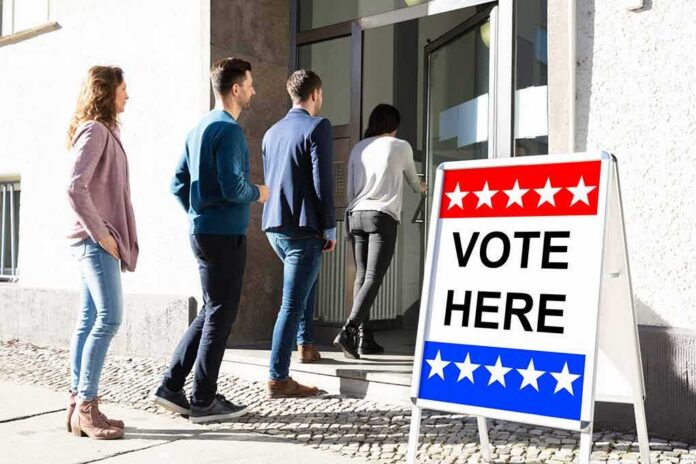
Men moved right in 2024, and the numbers show it was not a blip.
Story Snapshot
- Pew found men backed Trump by 12 points in 2024 after a near tie in 2020.
- Democrats’ edge with men under 50 vanished between 2020 and 2024.
- Young men’s party ID swung sharply toward Republicans since 2020.
- Black men stayed mostly Democratic but showed measurable GOP gains.
The measurable shift: who moved, and by how much
Pew Research Center’s validated-voter study reported that men favored Donald Trump by 12 points in 2024, 55 percent to 43 percent. In 2020, that split was much closer at 50 percent for Trump among men. The swing was most visible among men under 50. That group went from backing Joe Biden 53 percent to 43 percent in 2020 to a near tie in 2024, with Trump at 49 percent and Kamala Harris at 48 percent. That is erosion, not a trick of exits.
Party identification among young men moved too. Coverage of the Harvard youth survey reported Democrats held only a three-point advantage among young men in 2024. That was down from a 22-point edge in 2020, a large drop in brand loyalty over one cycle. The American Survey Center found a clear gender gap among younger voters: 57 percent of young women supported Harris compared with 45 percent of young men, a 12-point gap that shaped the map.
Black men: movement without a partisan flip
Associated Press VoteCast reported that Trump roughly doubled his share among young Black men. The gender gap grew most among younger Black and Latino voters. Still, the center of gravity stayed blue. A Houston Defender summary of validated-voter data put Black men at about 77 percent for Harris and 21 percent for Trump. That signals loss of margin, not a wholesale switch. Howard University’s 2024 Black Voters’ Poll also found Black women stood more firmly with Biden than Black men.
This two-part reality matters. Democrats still carry most Black men, but by smaller margins. Republicans are not winning the group, yet they are cutting into a core pillar of the Democratic coalition. Elections turn on margin math in close states. A two-to-five point shift among Black men can swing thousands of votes where it counts. That is how narrow races flip without a dramatic realignment headline.
Why the shift happened: separate facts from folk tales
The data prove the movement but do not prove the cause. Pew and Associated Press VoteCast report vote choice and demographics, not what messages or issues drove the change. Analysts have floated culture, crime, inflation, foreign policy, and views on masculinity. Some claim Democrats ignored men or talked past them. Those claims may ring true to some readers, but they are not tested here. The strongest fact pattern shows erosion among men, especially young men, not its final explanation.
OH Voted Early or Absentee as of 10/20/26 // 611,636
General Election
Party ID: Republican 38.0% / Democratic 50.0% / Nonpartisan 11.8% / Other 0.3%
Ages: 65+ 62.0% / 50-64 21.6% / 40-49 6.9% / 30-39 4.9% / 18-29 4.6% / Unknown 0.0%
Gender: Female 53.6% / Male 45.1% / Unknown… pic.twitter.com/KrqXPiOsR4— L2 Data (@L2political) October 20, 2026
Two cautions keep the picture honest. First, subgroup polling can be noisy when slicing by age and gender. The Atlantic warned against firm claims when many 2024 polls did not break out those cross-tabs cleanly. Second, Democrats did not collapse with men across the board. The party lost ground but still won many male voters, and Black men remained mostly Democratic. Overstating a “men are gone” story invites backlash and bad strategy.
What the numbers mean for both parties now
Republicans gained where it matters: young men and nonwhite men who had leaned left. That suggests issue space on work, wages, policing, and national strength. A disciplined message on safety, growth, and dignity can harden these gains. That aligns with conservative common sense: reward work, uphold order, and limit chaos. But Republicans should not assume a settled realignment. These voters remain movable if results disappoint or rhetoric drifts into culture-war overkill.
Democrats face a brand problem with men under 50. The party cannot afford to talk around crime, the cost of living, and merit. Voters hear tone as much as policy. If men think a party dislikes them, they shop elsewhere. The fix is not to mimic macho posturing. It is to speak plainly on jobs that pay, public safety that protects, and schools that teach skills. Compete for male voters again, as even Democratic analysts urged after 2024.
The next proof points to watch
Three tests will show if this was a blip or a break. First, validated-voter microdata that link 2020-to-2024 switchers with issues, not just demographics. Second, panel surveys that tie perceptions of masculinity and respect to vote change after controlling for inflation and candidate views. Third, ad and field audits that show whether outreach to young men and Black men matched the scale of Republican efforts. Until then, treat the shift as real, meaningful, and still movable.
Sources:
youtube.com, pewresearch.org, gs.howard.edu, americansurveycenter.org, deseret.com, defendernetwork.com, theatlantic.com
© standardheadlines.com 2026. All rights reserved.