
France poured nearly 3,000 police and gendarmes into Orléans as thousands rallied against the National Rally’s party congress, turning a routine meeting into a national stress test.
Story Snapshot
- Thousands marched in Orléans against the National Rally as it opened its congress.
- Officials counted about 11,000 protesters; organizers said 26,000, showing a wide gap.
- Roughly 50 parties, unions, and groups backed the protest with anti-racist, anti-fascist slogans.
- Authorities deployed armored vehicles, helicopters, and drones to manage risks.
Large Mobilization Targets National Rally Congress
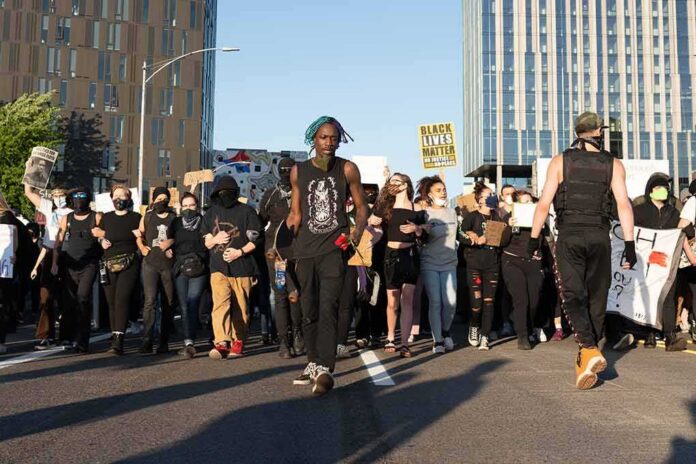
France 24 reported thousands marched in Orléans to oppose Marine Le Pen’s National Rally as the party opened its congress. The prefecture said around 11,000 people took part by midday. Organizers claimed 26,000, a major difference that shows how crowd counts can shape a story. Marchers carried anti-racist and anti-fascist signs. They aimed their message at the National Rally’s rise in French politics. The event drew citywide attention and heavy security planning.
Euronews said about 50 political parties, trade unions, student groups, and civic groups endorsed the protest and urged people to march against racism, fascism, and imperialism. That wide backing showed the protest was not a fringe action. It was a planned show of force by a broad coalition. Signs read “Racism is a crime,” and speakers warned about the party’s direction. The gathering set out to mark a bright line around what many called the limits of acceptable politics.
Security Operation Reflects Public-Order Fears
Euronews reported nearly 3,000 police and gendarmes were deployed, with armored vehicles, helicopters, and drones in use. Shops boarded windows, and transit shut down in parts of the city to lower risks. That level of force showed the government expected trouble even as many protesters planned a peaceful day. CBS News noted police used tear gas at points and made arrests across France during the broader wave of protests. In Orléans, the march itself ended peacefully earlier in the day.
The tight controls had tradeoffs. Strong security can reassure families and business owners. It can also make peaceful protesters feel watched or hemmed in. In Orléans, restrictions and images of armored vehicles risked turning focus from messages to management of crowds. That shift often happens in big demonstrations. The story moves from “why people marched” to “how the state kept order.” Reporters highlighted both angles as the congress proceeded behind the security cordon.
Competing Narratives and Disputed Numbers
The attendance gap mattered because it changed how people judged momentum. The prefecture’s 11,000 tally suggested a large but limited turnout. The organizers’ 26,000 claim pointed to a mass rejection of the congress. Without shared methods, counts became a proxy fight over legitimacy. France 24 and other outlets used terms like “anti-fascist” to describe the march and “far-right” for the National Rally, reflecting common media framing in France. That framing can harden views on both sides.
Opposition leaders used sharp words. The head of the General Confederation of Labour union, Sophie Binet, said the National Rally “will never be a party like the others,” calling it racist, antisemitic, and sexist. Those remarks showed how some unions and left parties see the party as beyond normal competition. At the same time, reporting tied the march to other grievances, like high living costs and limits on protest rights. That mix can blur the protest’s core aim.
Why This Matters Beyond France
Analysts say the National Rally has tried to “normalize” its image while keeping hard lines on immigration and national identity. That effort helps explain why the party draws bigger crowds and more votes in recent years. The Orléans march shows a counter-move: using street mobilization to mark moral boundaries. In the United States, readers know this pattern. Big security footprints, sharp labels, and crowd-size fights often replace debate on real policy tradeoffs that affect daily life and wallets.
Sources:
facebook.com, france24.com, cnn.com, euronews.com, cbsnews.com, letemps.ch
© standardheadlines.com 2026. All rights reserved.