

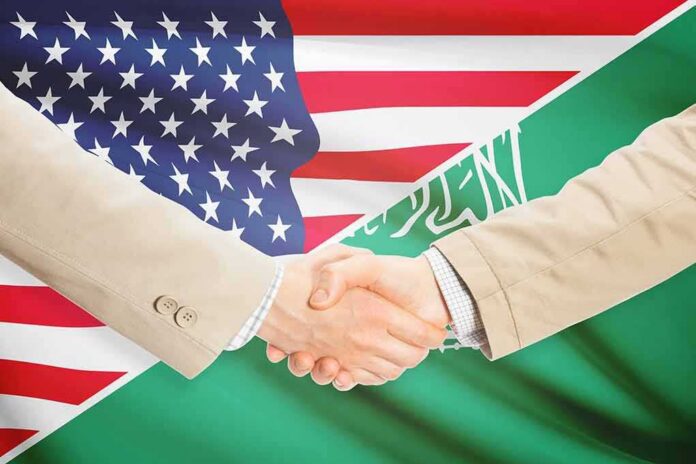
A landmark U.S.–Saudi nuclear deal promises big energy and jobs gains while quietly bending long‑standing nonproliferation guardrails.
Story Snapshot
- The Trump administration has completed a civil nuclear cooperation framework with Saudi Arabia built around a long-term, multi-billion-dollar partnership.
- The agreement positions American companies as Saudi Arabia’s preferred partners for nuclear reactors and technology, promising major commercial and jobs benefits at home.
- Key safeguards on uranium enrichment and intrusive inspections appear weaker than past U.S. policy, raising worries about a new nuclear race in the Middle East.
- Congress now faces a critical role in reviewing the deal and deciding how much nuclear freedom Washington gives a volatile region partner.
Trump’s Nuclear Deal With Riyadh: What Was Just Agreed
President Donald Trump’s team has finalized a civil nuclear cooperation framework with Saudi Arabia, centered on a Joint Declaration on the Completion of Negotiations on Civil Nuclear Energy Cooperation. The White House fact sheet says this declaration builds the legal base for a “decades-long, multi-billion-dollar nuclear energy partnership” and makes American firms the kingdom’s “civil nuclear cooperation partners of choice.” Energy Secretary Chris Wright has described it as a “historic” civilian nuclear deal focused on power generation in Saudi Arabia.
Under this framework, the United States and Saudi Arabia plan a formal agreement under Section 123 of the Atomic Energy Act, the standard tool that allows U.S. nuclear material, equipment, and technology exports. Saudi and American statements say the partnership will include U.S. reactor technology, nuclear power plants, and joint nuclear energy and radiological projects for peaceful uses. Both governments publicly stress “strong nonproliferation standards,” promising work with international safety and safeguards rules even as they open the door to advanced nuclear capabilities.
Economic and Energy Upside for the U.S. and the Kingdom
The Trump White House frames the deal first as an economic and energy win for American workers and businesses. By locking in U.S. firms as Saudi Arabia’s main partners for its civilian nuclear program, the agreement offers a large new market for American reactor designs, fuel, and support services. Saudi officials say the kingdom will use advanced U.S. nuclear technology to cut its reliance on oil for power, expand medical and industrial uses, and build local skills and infrastructure in line with international safety standards.
Analysts note that Saudi Arabia holds sizable uranium resources, which could eventually support a full domestic nuclear fuel cycle. Pro-deal experts argue that bringing those resources and future reactors under a U.S.-led commercial framework is better for safety than leaving the field to rival suppliers like Russia or China. Supporters also highlight the potential for high-quality manufacturing and engineering jobs in the United States tied to reactor exports and long-term service contracts, a theme that fits the Trump administration’s focus on rebuilding American industry.
Guardrails Weakened: Enrichment, Inspections, and Regional Risk
The picture grows more complex on the nuclear security side. A report to Congress seen by Reuters says President Trump intends to negotiate a 123 Agreement with Saudi Arabia that drops some nonproliferation conditions Washington has treated as standard since 2009. These include firm bans on domestic uranium enrichment, bans on reprocessing spent fuel, and a demand that partners adopt enhanced International Atomic Energy Agency inspection rules known as the Additional Protocol.
Media and nonproliferation groups describe the emerging deal as a “gilded sweetheart” pact that could allow Saudi Arabia to gain fuel-cycle capabilities over time with extra bilateral safeguards instead of the stricter global model. Experts warn that giving Riyadh more room on enrichment could push Iran and others to match or exceed that capability, feeding a regional nuclear arms race. Several lawmakers have already said any civil nuclear deal with Saudi Arabia must not spark such a competition and have signaled they will scrutinize the agreement closely.
Congress, Conservatives, and the Stakes for U.S. Power
Under U.S. law, Congress has to review and, in effect, accept any Section 123 nuclear cooperation agreement before major transfers can begin. The administration has already sent a report on the draft pact to Capitol Hill, starting a clock that could lead to formal submission of the agreement within months. Members now face a choice: protect long-standing nonproliferation rules or allow more flexibility to secure a strategic partner and big commercial gains in a region facing growing threats from Iran.
For conservative readers, the core tension is clear. On one side, this deal can strengthen American energy leadership, create jobs, and keep Saudi Arabia tied to U.S. technology instead of hostile powers. On the other, weakening nuclear guardrails with any Middle Eastern monarchy demands very careful oversight to avoid handing future leaders a path toward weapons. As the Trump administration moves to finalize the agreement, Congress’s response will shape not just the U.S.–Saudi partnership, but the rules of the nuclear game in the world’s most volatile neighborhood.
Sources:
mediaite.com, reuters.com, cnn.com, ans.org, armscontrol.org, thebreakthrough.org, energy.gov, brookings.edu, youtube.com, houseofsaud.com, whitehouse.gov, wagingpeace.org
© standardheadlines.com 2026. All rights reserved.