
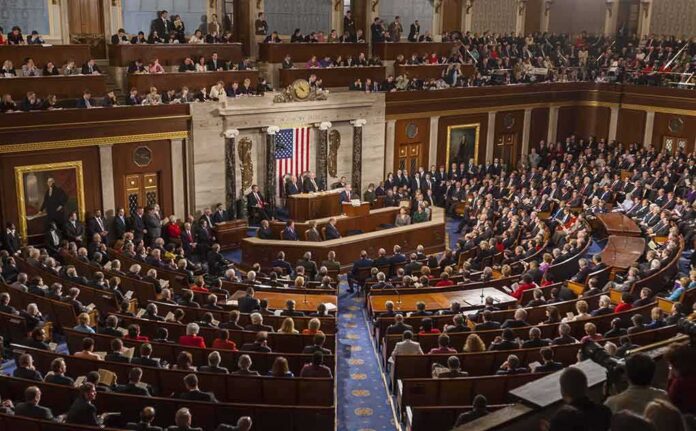
In a 352-72 vote, the House moved to make President Trump’s anti-fraud push a permanent force inside the Justice Department.
Story Snapshot
- The House passed H.R. 9576 to create a National Fraud Enforcement Division at the Department of Justice
- The bill establishes a Senate-confirmed Assistant Attorney General to lead nationwide fraud prosecutions
- House leaders tied the new division to funding and enforcement capacity, citing a $30 million line
- The Senate has not yet acted, so the bill is not law
House Locks In A New Anti-Fraud Mission
The House of Representatives approved H.R. 9576 by a recorded vote of 352-72 on September 16, 2026. The bill would establish a National Fraud Enforcement Division inside the Department of Justice, with a mandate to investigate and prosecute fraud against taxpayer dollars and programs. The decisive vote advanced through formal House procedure with a rule from the Committee on Rules. The measure now heads to the Senate for consideration before it can reach President Trump’s desk for signature.
The bill text makes the structure plain. It creates a permanent division and an Assistant Attorney General, appointed by the President and confirmed by the Senate, to run it. The aim is to centralize complex fraud cases that touch federal funds, health care programs, and other taxpayer-backed systems. Supporters argue the move will tighten program integrity and speed up cases by giving clear lines of authority inside the Department of Justice.
What The Bill Actually Does
H.R. 9576 states that “there is hereby established a National Fraud Enforcement Division” at the Department of Justice. It sets leadership at the Assistant Attorney General level and aligns the unit’s focus on fraud that drains taxpayer resources. That design places fraud enforcement on par with other major justice priorities. By elevating the role, Congress would give the division a seat at the table for strategy, hiring, and case selection across the country.
House Republicans also linked policy to resources. Appropriators publicly identified a $30 million funding line for the new division within the Commerce, Justice, Science spending bill. That detail signals an intent to match the mission with analysts, trial lawyers, agents on detail, and support staff. The pairing of authorization and funding is key for results. Without money and people, a new office is just paper. With both, it can build real case pipelines and recoveries.
Bipartisan But Not Unanimous
The vote crossed party lines by a wide margin, reflecting broad concern over fraud that wastes taxpayer dollars. Republicans backed the bill in force. Many Democrats joined them, though seventy-two opposed it. The size of the majority matters because it shows a shared interest in protecting federal funds. It also shows a split over how to structure enforcement and where power should sit within the Department of Justice. Even so, the House statement of purpose was clear and strong.
Key sponsors and supporters framed the outcome as a move to make the division permanent. They pointed to the bill’s plain wording, the leadership post, and the funding. They also emphasized the need to coordinate complex fraud cases, which often span many states and programs. One member described the vote as locking in a dedicated national unit focused on fraud against public funds, ending questions about whether this work would remain a side project or temporary task force.
Why It Matters For Taxpayers
Fraud drains money from seniors, families, and small businesses who pay into federal programs. Centralized enforcement can focus talent and data tools on the biggest schemes. A Senate-confirmed leader can set priorities and demand accountability from field offices. That structure can reduce overlap and close gaps that allow bad actors to play agencies against each other. The goal is simple: stop theft of taxpayer money, bring swift cases, and deter the next round of criminals.
It is time to investigate democrats who oppose efforts to stop Fraud in Federal welfare programs
Democrats who voted "No" to the PROOF Act must not want SNAP, TANF, COVID funds, and disaster aid fraud to be stopped. Could it be they are benefitting from continuing fraud in these…
— BarryMoore (@BarryMoore70635) September 17, 2026
The path ahead still runs through the Senate. House passage is a major step but not the finish line. If the Senate passes the bill and President Trump signs it, the division’s authority will rest on solid statutory ground. That would support hiring, training, analytics, and partnerships with inspectors general and United States Attorneys. Until then, the House vote stands as a strong signal that Congress wants fraud enforcement to be a lasting national priority, not a temporary fix.
Sources:
facebook.com, hamadeh.house.gov, congress.gov, docs.house.gov, quiverquant.com, clerk.house.gov
© standardheadlines.com 2026. All rights reserved.