

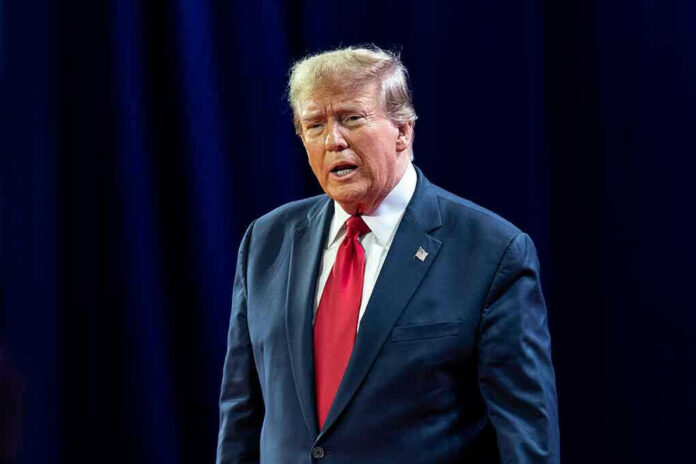
Trump just turned a wonky election bill into a loyalty test that could decide who survives the next primary season.
Quick Take
- Trump vowed he will not endorse any lawmaker, Republican or Democrat, who votes against the SAVE America Act.
- The House passed the bill in February 2026, but Senate math makes a 60-vote path unlikely without Democrats.
- The bill pairs proof-of-citizenship and tighter voting rules with culture-war provisions, raising the stakes for both parties.
- Senate leaders are using a test vote to put Democrats on record and pressure GOP holdouts.
Trump’s endorsement threat turns Senate procedure into a political weapon
Trump’s Truth Social warning landed as Senate Republicans prepared a procedural test vote, the kind of inside-baseball moment most voters never notice. Trump forced everyone to notice anyway. He framed the SAVE America Act as historic and promised political consequences for “no” votes, a message aimed as much at wary Republicans as at unified Democrats. In a party where endorsements can shape primaries, that threat functions like a whip.
Senate Majority Leader John Thune’s blunt assessment that the votes aren’t there under current rules tells you why the pressure campaign matters. The filibuster threshold turns legislation into arithmetic, not enthusiasm. A test vote can still serve a purpose: it creates a paper trail and a campaign ad. Trump’s message signals he wants that roll call to hurt, even if the bill stalls.
What the SAVE America Act tries to do, and why it’s not a standard voter ID fight
The bill’s core pitch centers on election integrity: proof of U.S. citizenship for federal voter registration, stricter voter ID expectations, and limits on mail-in voting. That alone would ignite a familiar national argument about access versus security. The 2026 version goes further by bundling hot-button social provisions, including restrictions connected to transgender athletes and medical care for minors, packaging multiple conservative priorities into one do-or-die vote.
That bundling changes the strategic landscape. A clean election-security bill can attract a few cross-pressured Democrats in theory, especially in swing states. A bill that mixes election rules with cultural flashpoints dares opponents to reject the whole agenda at once. Supporters call it common sense and long overdue; opponents call it suppression with extra ideological riders. Either way, it hardens partisan edges and makes “compromise” politically radioactive.
Why Republicans are pushing a vote they may lose
House Republicans passed the measure largely along party lines in February 2026, then watched it run into the Senate’s 60-vote reality. That doesn’t make the effort pointless; it makes it tactical. A test vote forces Democrats to publicly block it, which Republicans can frame as opposition to voter eligibility checks and election safeguards. It also exposes Republican dissenters, including figures like Sen. Lisa Murkowski, to base anger and potential primary heat.
Some Republicans have floated alternative routes, including attaching parts of the package to must-pass legislation. That tactic can work, but it also invites blowback when unrelated priorities get stapled together under deadline pressure. Trump’s posture suggests he prefers maximal leverage over incremental wins. From a conservative, common-sense perspective, demanding proof of citizenship to vote in federal elections is an easy sell; the challenge is persuading skeptics that the bill’s breadth won’t create unintended chaos for states.
The Democrats’ counterattack: “Jim Crow 2.0” and the politics of distrust
Chuck Schumer’s “Jim Crow 2.0” label is designed to shut down the debate before it starts, and it’s powerful rhetoric because it invokes moral emergency. Democrats argue strict documentation and ID requirements can hit seniors, low-income Americans, and minority voters hardest, especially if obtaining documents costs time and money. Republicans respond that rules mean nothing without enforcement and that Americans show ID for far less important things than voting.
Common sense says both fears can exist at once: a nation should verify citizenship for federal elections, and the system should not punish eligible voters who struggle with paperwork. The real test is implementation. If Congress mandates stricter standards, it also inherits responsibility for making compliance realistic, uniform, and resistant to bureaucratic failure. That’s where many election bills collapse: not on the principle, but on the details states have to live with.
The endgame: Senate math, lawsuits, and a campaign issue built to last
Even if the SAVE America Act doesn’t clear the Senate now, it’s already doing its job as a political instrument. Trump has tied it to endorsements, activists are being told to pressure senators, and Republicans can campaign on Democrats’ unified resistance. If a future version passes, legal challenges are likely, and states would face expensive, complicated system changes. If it fails, the issue still fuels turnout by keeping election trust on the front burner.
NEW: President Trump fires off a warning to Republicans, tying the Save America Act directly to the party’s future in the Senate.
“Not passing the SAVE AMERICA ACT will lead to the worst results… An Unrecoverable Death Wish!!!”
He doesn’t stop there — he also pushes to scrap… pic.twitter.com/w5aMARP6I1
— Fox News (@FoxNews) April 25, 2026
The deeper story is how Trump uses a bill to enforce party discipline without holding a gavel. Endorsements aren’t policy, but they shape who writes policy next year. For voters over 40 who remember when election rules were a dull county-clerk topic, this is the new reality: procedure becomes spectacle, legislation becomes a litmus test, and the fight isn’t only over ballots. It’s over who gets to define “legitimate” in American politics.
Sources:
Trump warns he won’t endorse lawmakers who oppose Save America Act
Trump urges Senate to pass SAVE America Act, warns he’ll oppose lawmakers who vote no
Donald Trump, SAVE America Act, Republicans, Voting, John Thune, Chuck Schumer