
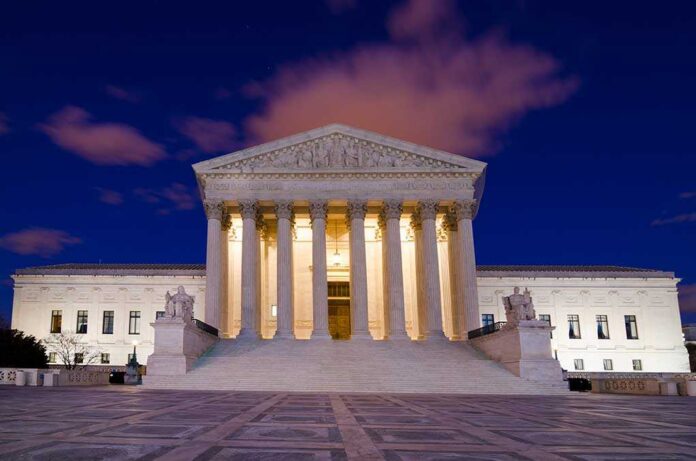
The Supreme Court just yanked away one of President Trump’s fastest emergency tools for confronting foreign threats—by ruling his IEEPA-based tariffs were never legally authorized in the first place.
Quick Take
- The Supreme Court ruled 6-3 on Feb. 20, 2026, that the International Emergency Economic Powers Act (IEEPA) does not authorize presidents to impose tariffs.
- The decision invalidated Trump’s “Liberation Day” tariffs tied to declared emergencies involving fentanyl-linked drug flows and trade deficits.
- Chief Justice John Roberts wrote the opinion, applying a “major questions” style analysis requiring clear congressional authorization for sweeping tariff power.
- Three dissenting justices warned the ruling “handcuffs” the president’s ability to respond quickly to foreign crises using economic leverage.
What the Court Struck Down and Why It Matters
The Supreme Court’s Feb. 20 decision in Learning Resources, Inc. v. Trump rejected the administration’s use of IEEPA—a 1977 statute typically used for sanctions and asset freezes—as the legal basis for broad import tariffs. The majority concluded that even though IEEPA lets presidents “regulate” certain economic activity during national emergencies, it does not clearly grant the power to impose tariffs. That distinction matters because the Constitution assigns tariff authority to Congress.
The ruling landed in the middle of Trump’s second-term push to reassert U.S. leverage over hostile or non-cooperative foreign actors. After returning to office, Trump declared national emergencies tied to threats that included international drug trafficking and persistent trade deficits undermining U.S. manufacturing and supply chains. Under that framework, the administration rolled out “Liberation Day” tariffs starting April 2, 2025, including a broad baseline duty and higher rates for certain countries.
The “Major Questions” Problem: Congress Didn’t Speak Clearly
Chief Justice Roberts’ opinion emphasized a basic separation-of-powers point conservatives have argued for years in other contexts: when an action carries vast economic and political consequences, a president (or an agency) needs clear authorization from Congress. The Court treated broad, economy-wide tariffs as exactly that kind of “major question.” In practical terms, the majority read IEEPA as too vague to be stretched into a sweeping tariff statute, especially when Congress has written more explicit tariff delegations elsewhere.
The justices’ split also highlighted an uncomfortable reality for anyone who assumed “conservative court equals predictable outcomes.” Two Trump appointees—Justices Neil Gorsuch and Amy Coney Barrett—joined the majority alongside the Court’s liberals. That coalition signals the Court was focused more on statutory text and institutional limits than on partisan outcomes. For supporters of limited government, the majority’s logic is coherent: Congress writes tariff laws, and presidents execute them.
What the Three-Justice Dissent Warned About
The dissenters—reported as three justices including Brett Kavanaugh—argued that the majority’s reading strips the president of flexibility precisely when speed matters. According to accounts of the dissent, Kavanaugh stressed “context and common sense,” contending that IEEPA’s grant to regulate importation during an emergency can encompass tariff-like measures even if the word “tariff” does not appear. The dissent’s bottom line: foreign threats move faster than Congress, and the Court is narrowing tools presidents have long used to respond.
That warning resonates with many voters who watched years of porous borders, fentanyl deaths, and a global trade order tilted against American labor and industry. Still, the dispute here is less about whether the problems are real and more about who holds the pen. The majority concluded that if tariffs are the chosen weapon, Congress must authorize them clearly. The dissent responded that emergencies don’t wait for legislative calendars and committee negotiations.
Immediate Fallout: Collections Halted, Refund Fights Begin
Because the Court invalidated the tariff program, the ruling immediately halted collection under the challenged IEEPA tariffs and opened the door to refund claims—potentially in the billions—by importers who paid the duties. The lead plaintiff, Learning Resources, Inc., challenged the tariffs as beyond what IEEPA allows. Reporting also flagged broader uncertainty for trade partners and negotiated arrangements—such as tariff reductions with allies—that were structured around the now-invalid framework.
For everyday Americans, the near-term effects are mixed and hard to pin down from the available information. Tariffs can raise costs on imported goods, but they are also used as leverage—especially when the goal is to pressure foreign governments tied to drug flows or unfair trade practices. The decision forces the administration to either find a different statutory authority (where available) or go to Congress for a tailored law that can survive judicial review.
What Comes Next: A Constitutional Flashpoint for Trump’s Agenda
The ruling effectively draws a bright line: IEEPA is a sanctions-and-controls statute, not a blank check for sweeping tariff policy. That will shape not only Trump’s next moves, but also what future presidents can do during declared national emergencies. For conservatives wary of executive overreach, there’s a real principle at stake—presidents shouldn’t invent powers from ambiguous text. For conservatives focused on national sovereignty and security, there’s also a practical concern—America can’t afford to be slow-footed when adversaries exploit trade and drug pipelines.
Three Justices WARN Majority Is Handcuffing President Trump’s Ability to Fight Foreign Threats — Here’s What the Three Justices Said in Their Dissent https://t.co/zbDnKBkGfx #gatewaypundit via @gatewaypundit Justices Kavanaugh, Thomas, and Alito, issued a blistering dissent,…
— AtomBob (@atombob357) February 20, 2026
The most likely resolution is political rather than judicial: Congress can clarify what emergency economic powers include, and under what limits, if lawmakers believe tariffs should be available in defined circumstances like drug trafficking or supply-chain coercion. Until then, the Court has signaled that big, economy-shaping actions require unmistakable legislative permission. That’s a major constraint on Trump’s playbook—and a major invitation for Congress to finally do its job.
Sources:
Supreme Court strikes down tariffs
Learning Resources, Inc. v. Trump, 607 U.S. (24-1287)
Supreme Court tarriffs ruling trump
Trump tariffs Supreme Court ruling
U.S. Supreme Court invalidates IEEPA as a lawful authority to impose tariffs