

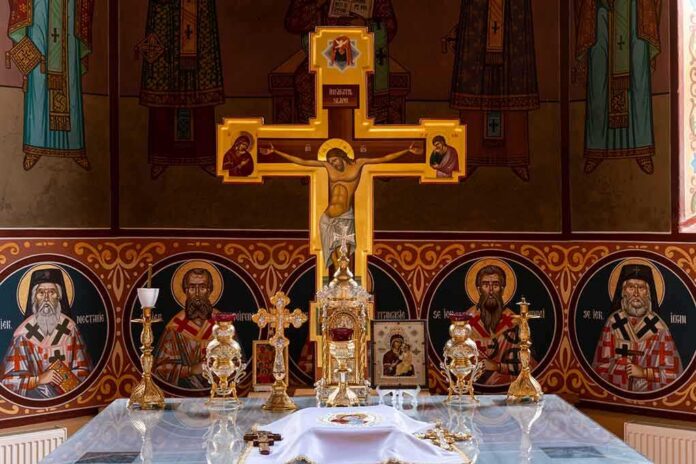
Police in Vilnius say a golden Jesus statue was torn from a church cross and later shattered on a nearby street, turning a sacred symbol into broken pieces overnight.
Story Highlights
- Vilnius Police opened a public-order case after a golden Jesus statue was broken downtown.
- Reports describe video of two men handling the statue before it smashed on the pavement.
- The shrine’s priest asked for help to identify suspects after the late-night incident.
- Authorities are assessing damage and have not confirmed suspect identities or theft charges.
What Police Say Happened in Vilnius
Vilnius Police reported that on November 11, 2026, around 9:00 p.m., an unidentified person broke a golden Jesus statue that had hung on a wooden cross inside a church courtyard. Officers opened a pre-trial investigation for a public-order offense under Article 284 of Lithuania’s Criminal Code. Police also said the damage was being assessed. These are the most concrete official facts made public so far about the event and the legal step taken.
Local and international outlets report that cameras captured much of the incident. The reports describe two men seen handling or posing with the statue before it fell and shattered on Dominikonų Street, in Vilnius Old Town. The accounts say the figure’s head, torso, and arms hit the pavement and broke into pieces. The reports also connect the broken statue to the Shrine of Divine Mercy courtyard, where the figure had been mounted on a cross.
What the Church and Community Reported
Father Elijas Anatolijus Markauskas, the shrine’s priest, said the statue was torn from the cross and broken during the night of November 11 to 12. He appealed on social media for help in identifying the person or people involved. A statement attributed to the shrine expressed grief over the fragments and stressed that the harm went beyond the loss of a simple object. These public comments helped rally attention and support after the smash-up.
Community responses frame the statue as a sacred symbol. Many see the act as more than a property crime. Still, the official process remains focused on public order and damage. Police have not published a completed assessment of the statue’s condition or cost. Officials have also not released the object’s age, appraised value, or any heritage-list status. That means the case, for now, sits in the box of vandalism against a religious image, not a declared heritage crime.
Unresolved Details and the Legal Track
Several reports describe the men as suspected British tourists and suggest alcohol played a role. Police communications cited in coverage, however, did not confirm the suspects’ identities or announce theft charges. The public-order investigation is the formal step on record. That keeps the focus on what authorities can prove with evidence, including any video, witness accounts, and the recovery of fragments for review and repair planning.
Police have identified a suspect accused of desecrating a sculpture of Jesus on the cross from the Divine Mercy Sanctuary in Lithuania’s capital.
According to the police, the man removed the sculpture from a wooden cross in the church courtyard. CCTV footage captured him… pic.twitter.com/Z5Ymg2hDxJ
— TVP World (@TVPWorld_com) November 15, 2026
Why this matters reaches beyond Vilnius. Religious images are more than art or metal. They mark identity, memory, and shared belief. When someone rips a figure of Jesus from a cross and smashes it, the blow lands on a community’s sense of respect and order. People on the right and left worry that basic norms are slipping. This case shows how fast a late-night stunt can turn into a deep wound for many people who only want space to pray in peace.
How This Fits a Wider Pattern
Scholars and lawmakers have long noted the special role of religious objects. Some see acts like this as chaos or drunken recklessness. Others see it as a symbolic attack. The same swing of an arm can look very different depending on what it hits and what it means to a community. European policy statements warn against damage to cultural and religious heritage, even outside war zones, because it shakes social trust and shared life.
What to Watch Next
Next steps include the police damage report, any suspect identification, and a charging decision. A repair plan may follow if experts say restoration is possible. The shrine will likely decide whether to replace the figure on the cross or hold the fragments for memory and teaching. These choices will shape how the community heals and how visitors learn to treat sacred spaces with care and respect during travel and nightlife.
Sources:
lifesitenews.com, premierchristian.news, newsit.gr, metro.co.uk, us.headtopics.com
© standardheadlines.com 2026. All rights reserved.