

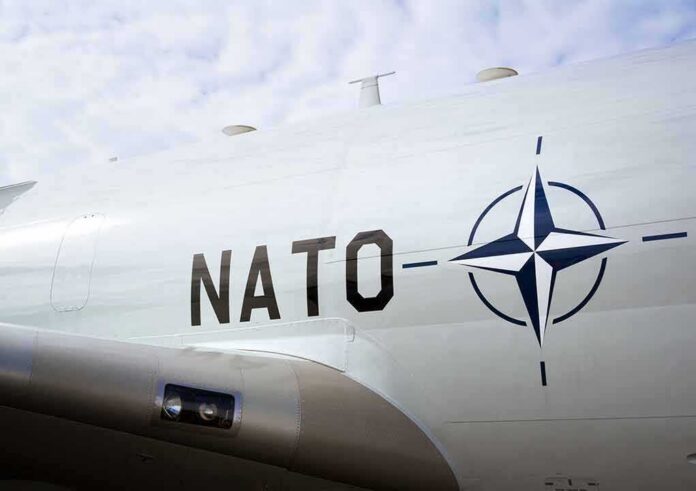
Five Nordic flags just snapped into one defense picture, and NATO’s northern flank looks far tougher because of it.
Story Snapshot
- Finland and Sweden joined NATO, linking Nordic plans and forces to Alliance defense in the High North and Baltic Sea
- Nordic defense ministers set a shared goal to operate together and built a 2030 roadmap tied to NATO plans
- Air forces already fly combined missions and now have cross-border airspace to train faster and at scale
- New NATO initiatives add Arctic communications and heavy-lift networks to the Nordic toolkit
Nordic accessions turn a map advantage into a military plan
Finland and Sweden’s accessions reshaped NATO’s geography and planning. Finland’s border with Russia and Sweden’s Baltic access now sit inside NATO’s command structure, with the Washington Summit calling for full integration of Finnish and Swedish forces into Alliance plans and headquarters. NATO highlights that Sweden’s accession followed Finland’s in 2023 and strengthens defense in the High North and the Baltic Sea. This closes a seam that long split planning, logistics, and air defense across the region.
Nordic defense leaders moved early to make this real. In 2020, Norway, Finland, and Sweden signed a Statement of Intent to build the readiness to conduct operations together, subject to national decisions. In 2024, Nordic governments adopted a Vision that ties their cooperation to NATO’s collective defense, with targets for combined-joint operations, shared planning, logistics, host-nation support, and military mobility by 2030. The roadmap sets milestones that can be measured by exercises, command timelines, and actual troop movements.
Air power shows the fastest gains
Nordic air chiefs have turned talk into flying hours. Allied Air Command reported joint air policing, mixed scrambles, and paired missions across borders. Recent drills paired Finnish F/A-18s with Norwegian F-35s in shared scenarios, building tactics and communications that match NATO standards. A July 2024 declaration by Denmark, Finland, Iceland, Norway, and Sweden opened more national airspace for training, exercises, and other Alliance air activity. This change cuts friction and speeds coordination across long distances.
Unified air activity matters because deterrence in the north begins in the sky. Shared alerting and a larger, integrated radar and command picture raise the cost of any probe. More cross-border training also lifts sortie generation and readiness across five small but modern air forces. That is classic deterrence by denial: show you can see, decide, and act faster than a challenger can escalate. The result is a thicker air shield over sea lanes, pipelines, and reinforcement routes.
Command links, logistics, and mobility tighten the weave
NATO’s military leadership says the Nordic Defence Concept now aligns national and Alliance defense plans and enables a smooth shift into NATO regional plans. A planned NATO Multi-Corps Land Component Command in Mikkeli, Finland, anchors land coordination, while Sweden stands ready to act as a framework nation for a multinational battlegroup in Finland. These moves connect national brigades, depots, and railheads to a common playbook that can scale in crisis.
The 2030 Vision goes beyond operations to the plumbing that wins wars: logistics, host-nation support, and military mobility. The plan calls for common operations planning, shared sustainment, and faster movement across borders. That focus fits conservative common sense: elegant speeches do not move fuel, but synchronized rail, roads, and ports do. When forces can roll from northern Norway to Finland with one set of papers and standard procedures, the map starts to favor the defender.
Space, sea lanes, and the Arctic backstop
NATO launched initiatives that plug Nordic needs into a wider lattice. NORTHLINK brings Denmark, Finland, Iceland, Norway, Sweden, the United States, and others together to harden Arctic satellite communications. STARLIFT links nations to improve strategic airlift and heavy supply flows. These programs add resilient command-and-control and long-haul logistics. They also reduce single points of failure in a region where weather, distance, and polar latitudes punish sloppy planning.
.@PesuMatti discusses the regional deterrence cluster formed by Denmark, Finland, Iceland, Norway, and Sweden—and argues that “the Nordic model offers a glimpse of the adaptive solutions that may sustain NATO through uncertain times.” https://t.co/N2rUDf5kav
— Foreign Affairs (@ForeignAffairs) October 30, 2026
This framework is not a blank check for automatic joint action; the 2020 statement is not legally binding and keeps national decisions in national hands. But the direction is locked in by NATO planning and real activity. Exercises aim to expose flaws so commanders can fix them, and the Alliance has tied Finnish and Swedish capabilities into its structures by design. That process builds a credible day-one posture, which is the heart of deterrence: a ready team that does not bluff.
Sources:
realcleardefense.com, nato.int, government.se, ac.nato.int, tandfonline.com
© standardheadlines.com 2026. All rights reserved.