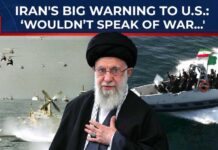

When Iran’s Revolutionary Guard closed the world’s most critical oil chokepoint after U.S. airstrikes killed their supreme leader, naval escorts became a band-aid solution to a problem that might only yield to American boots on Iranian soil.
Story Snapshot
- Iran effectively shut down the Strait of Hormuz after U.S.-Israel strikes killed Supreme Leader Ali Khamenei on February 28, 2026, triggering 16 ship attacks in two weeks
- Naval escorts can sustain only three to four ships daily through the strait, a logistically unsustainable solution for the conduit that carries 20 percent of global oil and gas trade
- Military analysts suggest ground forces to secure Iranian coastal territory may be the only way to guarantee long-term shipping access and prevent global economic collapse
- Iran deployed naval mines, drones, and midget submarines while coordinating with Hezbollah, demonstrating asymmetric warfare capabilities that challenge conventional naval responses
The Crisis That Changed Everything
Operation Epic Fury changed the calculus overnight. The joint U.S.-Israeli strikes on February 28, 2026, killed Iran’s Supreme Leader Ali Khamenei along with destroying nuclear facilities and military installations. Iran’s retaliation came swiftly and devastatingly. Revolutionary Guard forces fired missiles at U.S. bases across the Gulf, launched attacks on Israel, and broadcast VHF warnings that sent 70 percent of Strait of Hormuz shipping traffic fleeing. By March 2, the IRGC declared the strait closed, striking the U.S.-flagged Stena Imperative at Bahrain’s port as punctuation to their intent.
The escalation accelerated with chilling efficiency. March 4 saw the IRGC claim full control while striking the Malta-flagged Safeen Prestige. Within days, tugboats sank, American tankers absorbed drone impacts, and naval mines appeared in shipping lanes. By March 12, authorities tallied 16 confirmed attacks and four suspicious incidents. The world’s energy jugular now pulsed under Iranian thumbs, with each heartbeat threatening to flatline the global economy. Unlike previous Hormuz tensions in 2019 or the 1980s Tanker War, this crisis involved targeted leadership assassination and comprehensive maritime interdiction backed by multi-front proxy warfare.
Why Ships Alone Cannot Win This Fight
President Trump promised naval escorts “as soon as possible,” and France launched Operation Aspides with twelve vessels. Energy Secretary Wright projected convoy operations beginning late March after degrading Iranian capabilities. The mathematics, however, tell a sobering story. Military assessments indicate seven to eight destroyers could shepherd only three to four commercial ships daily through the gauntlet. The strait normally handles dozens of tankers and cargo vessels each day. This arithmetic dead-ends at economic catastrophe within weeks, not months.
Iran’s asymmetric arsenal compounds the naval equation’s futility. Revolutionary Guard forces deploy fast attack boats, drone swarms, coastal anti-ship missiles, and critically, midget submarines that conventional destroyers struggle to detect and eliminate. These submarines can lay mines, launch torpedoes, and vanish into shallow coastal waters where American warships dare not follow. Naval power projection meets its match against an adversary willing to sacrifice conventional military assets for strategic chokepoint control. Every mine cleared spawns another planted overnight. Every drone destroyed launches from mobile launchers already relocated.
The Case for Ground Operations
Securing Iranian coastal territory adjacent to the strait offers what naval patrols cannot: persistent area denial against IRGC operations. Ground forces could establish security zones encompassing launch sites, mine-laying infrastructure, and command facilities that direct maritime attacks. This approach mirrors historical precedents where chokepoint control demanded territorial possession, not just naval presence. The 1980s Tanker War demonstrated that ships alone could not stop Iranian harassment; only Desert Storm’s comprehensive destruction of Iraqi capabilities through combined arms restored Gulf security.
Boots on the Ground in Iran: One Way to Keep the Strait of Hormuz Openhttps://t.co/4bN4z6e3EQ
— 19FortyFive (@19_forty_five) March 13, 2026
The counterarguments carry weight. Ground operations would require tens of thousands of troops, air superiority maintenance, logistics chains stretching across hostile territory, and acceptance of American casualties. Iran’s geography favors defenders, with mountainous terrain and urban areas perfect for asymmetric resistance. Regional allies hosting U.S. bases already absorbed Iranian missile strikes; their appetite for hosting invasion staging grounds remains questionable. The political cost at home and diplomatic fallout internationally could outweigh strategic benefits. Yet each day the strait remains closed, oil prices spike further, Asian and European economies hemorrhage, and the recession threat metastasizes into certainty.
The Unthinkable Calculus
America faces choices between bad and worse. Naval escorts buy time but solve nothing permanently. Economic sanctions mean little when Iran already endures maximum pressure. Continued airstrikes might degrade capabilities but cannot hold territory. Ground forces represent the only option guaranteeing long-term strait access, yet carry costs that make policymakers blanch. The IRGC understands this calculus perfectly, which explains their confidence in threatening Gulf banks and American firms while coordinating rocket attacks with Hezbollah across multiple fronts.
The 2026 Strait of Hormuz crisis exposes the fragility underlying globalized energy markets and the limits of naval power against determined regional adversaries. Iran possesses home-field advantage, ideological commitment, and asymmetric tools specifically designed to neutralize American conventional superiority. Whether boots on the ground become necessary or inevitable remains the question that will define this confrontation. The clock ticks toward economic collapse or military escalation, and half-measures accomplish neither security nor retreat. Sometimes the only way through a chokepoint is to seize both sides and hold them, regardless of the cost.
Sources:
2026 Strait of Hormuz crisis – Wikipedia
Report to Congress on the Iran Conflict and Strait of Hormuz – USNI News