

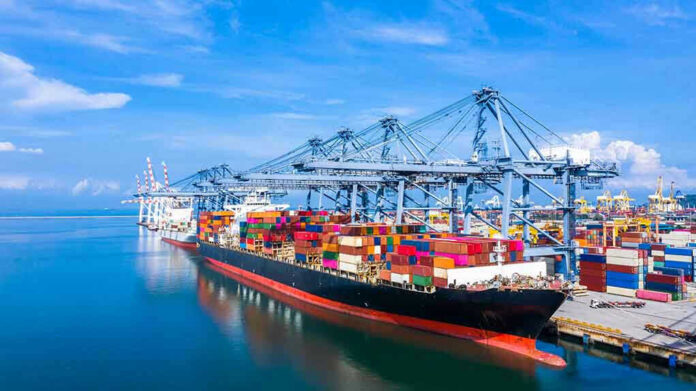
The UN’s new global carbon pricing mechanism for shipping emissions has drawn fierce criticism, with many labeling it as “taxation without representation.”
Story Highlights
- The IMO’s carbon pricing mechanism targets net-zero emissions by 2050.
- Critics argue the scheme lacks fair representation for developing nations.
- Shipping industry faces increased compliance costs and market disruptions.
- Concerns over the legitimacy and economic impact of the decision-making process.
Global Carbon Pricing Scheme Sparks Controversy
In April 2025, the United Nations’ International Maritime Organization (IMO) agreed on a global carbon pricing mechanism targeting shipping emissions, aiming for net-zero emissions by 2050. This scheme, however, has ignited substantial controversy as stakeholders criticize the lack of representation for many affected parties. Developing countries and smaller shipping states have voiced their discontent, labeling the initiative as a form of “taxation without representation.” The decision-making process has raised concerns over fairness and economic impact.
This framework, which applies to ships over 5,000 gross tonnage, covers 85% of the sector’s emissions. It introduces the first global carbon pricing mechanism for shipping, a move seen by some as a critical step towards addressing climate change. However, the decision-making process at the IMO has been criticized for marginalizing smaller and developing nations, raising questions about the legitimacy of the new regulations.
Critics argue that the scheme imposes significant costs on shipping nations and operators without adequate representation or input from all affected parties. This has led to accusations of unfair economic burdens, particularly for vulnerable nations that depend heavily on maritime trade. The framework also establishes a Net-Zero Fund to support these countries, but concerns remain about equitable access and governance.
Implications for the Shipping Industry
The IMO’s carbon pricing mechanism is expected to increase compliance costs for shipping operators, prompting uncertainty and potential disruption in global shipping markets. In the short term, there will be an immediate need for investment in cleaner technologies and fuels. The long-term implications may include an acceleration of decarbonization efforts within the shipping industry, restructuring of global shipping routes, and potential market consolidation favoring larger, well-capitalized operators.
Shipping companies, especially those with older, less efficient vessels, are likely to be most affected by these changes. Consumers may also face potential increases in shipping costs as these additional expenses are passed down the supply chain. The redistribution of costs across the sector could lead to political tensions between developed and developing countries over issues of fairness and representation.
Evaluating the Framework’s Success
The success of the IMO’s Net-Zero Framework will largely depend on its effective implementation and the support provided to vulnerable nations. While proponents argue that the scheme is a necessary step for climate action and modernization of the industry, critics remain focused on the fairness and economic impacts, especially for smaller nations. The ongoing debates highlight the challenges of balancing climate goals with economic realities.
IMO Secretary-General Arsenio Dominguez has praised the collaborative spirit but acknowledged the difficult negotiations and opposition from several countries, including the US. As the framework awaits formal adoption in October 2025, many eyes are on the IMO to ensure that implementation details address the concerns of all stakeholders involved.
Sources:
UN News: April 2025 Agreement on Net-Zero Framework
UN News: Updates on IMO Framework Developments
World Bank: Analysis of New Climate Deal for Shipping
Wikipedia: IMO Net-Zero Framework Overview