
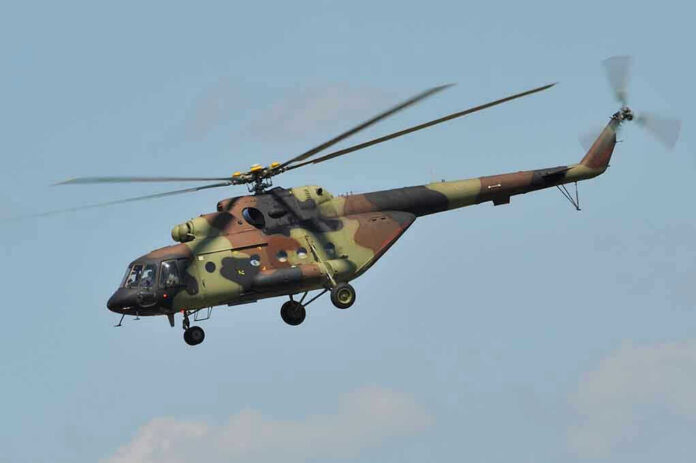
Two Apache attack helicopters hovering over a celebrity’s private “Southern White House” has conservatives asking a simple question: who approved this, and who paid for it?
Story Snapshot
- Kid Rock posted video showing two AH-64 Apache helicopters hovering near his Nashville mansion on March 28, 2026.
- The clip shows him saluting the aircraft near a replica Statue of Liberty and pairing the post with a patriotic caption and a jab at California Gov. Gavin Newsom.
- Online backlash focused on whether tightly controlled U.S. Army assets were used for a private, staged-looking moment—and what that could mean for taxpayer accountability.
- No public U.S. Army confirmation has clarified whether the flyby was authorized, routine training, or something else.
What the video showed—and why it immediately raised eyebrows
Kid Rock (Robert James Ritchie) posted the weekend video on March 28, 2026, showing two AH-64 Apache attack helicopters hovering low over his Nashville property, which he has long branded the “Southern White House.” The footage includes Kid Rock saluting near a poolside replica Statue of Liberty and praising those who “made the ultimate sacrifice,” while also taking a political swipe at Gov. Gavin Newsom.
The blowback wasn’t mainly about patriotism. Critics questioned whether the optics suggested privileged access to military hardware and whether the public was effectively underwriting a celebrity’s social media content. Supporters read the clip as a pro-military tribute. The central problem, based on available reporting, is that the public still lacks basic facts: which unit flew the aircraft, whether the pass was scheduled training, and what approvals were involved.
Why Apaches aren’t treated like casual flyovers
AH-64 Apaches are U.S. Army attack helicopters with missions and operating rules that make them different from the types of aircraft the public commonly sees at stadium flyovers. That distinction is why the clip drew attention beyond typical celebrity-post controversy. Reporting emphasized that Apaches are not normally associated with casual, civilian-facing displays, which is exactly why viewers immediately asked whether the event was planned for content rather than necessity.
Military flyovers can be legitimate when tied to training requirements and authorized under established processes. The difficulty in this case is that the location—above a private residence—doesn’t resemble a public ceremony or a widely scheduled civic event. Without an Army statement, the public is left to guess whether the helicopters were simply operating nearby as part of routine training or whether they were directed toward the property for a specific moment.
Taxpayer accountability vs. culture-war optics
Conservatives have long argued that government must justify spending and avoid favoritism, especially when budgets are strained and families feel squeezed by high costs. That’s why this story lands awkwardly: the image of two taxpayer-funded attack helicopters hovering at a celebrity’s mansion invites questions about cost, priorities, and equal treatment. Some criticism also focused on whether the moment looked staged, blurring the line between support for the troops and using the troops as props.
At the same time, the reporting does not establish key details needed to prove misuse. No outlet cited an official cost figure for this specific flight, and no confirmed documentation is provided showing the mission’s purpose. What is clear is that the public reaction split into familiar camps—patriotism versus “waste”—while the missing information kept the debate stuck at the level of optics rather than verified facts.
What “Army reviewing” likely means—and what remains unconfirmed
Coverage described the episode as the Army “reviewing” an apparent flyby, but the available reporting also acknowledges that no public Army confirmation has explained the circumstances. That limitation matters. A review could range from a routine internal check—confirming the flight was authorized training—to a deeper look at whether protocols were followed and whether any individual improperly arranged a high-profile pass over a private property.
Until official information is released, the responsible takeaway is narrow: the incident has raised public scrutiny because Apaches are not typical flyover aircraft, and because the setting is a private estate with a political-media brand attached to it. If the Army later confirms the flight was ordinary training, the story becomes mainly about social media optics. If it wasn’t, it becomes a question of accountability.
Why this story hits a nerve inside the broader “no more endless wars” debate
The controversy arrives at a moment when many Trump voters are already divided over America’s role in foreign conflicts, including rising tensions around Iran and persistent questions about U.S. obligations abroad. Many in the MAGA coalition are tired of open-ended commitments, skeptical of foreign entanglements, and frustrated that Washington’s priorities don’t match everyday Americans’ needs. That mood intensifies scrutiny when military assets appear to be used casually.
For constitutional conservatives, the principle is straightforward: the military exists to defend the nation, not to serve as a backdrop for domestic political signaling or celebrity branding. The reporting so far doesn’t prove wrongdoing, but it does show why the public is demanding clarity. If federal agencies want trust—especially from a base increasingly skeptical of “business as usual”—they can’t rely on silence when questions of protocol and public expense are raised.
Sources:
https://bluntmag.com.au/news/kid-rock-helicopter-nashville-mansion-southern-white-house/
https://www.alternativenation.net/kid-rock-draws-backlash-over-military-helicopter-video/