

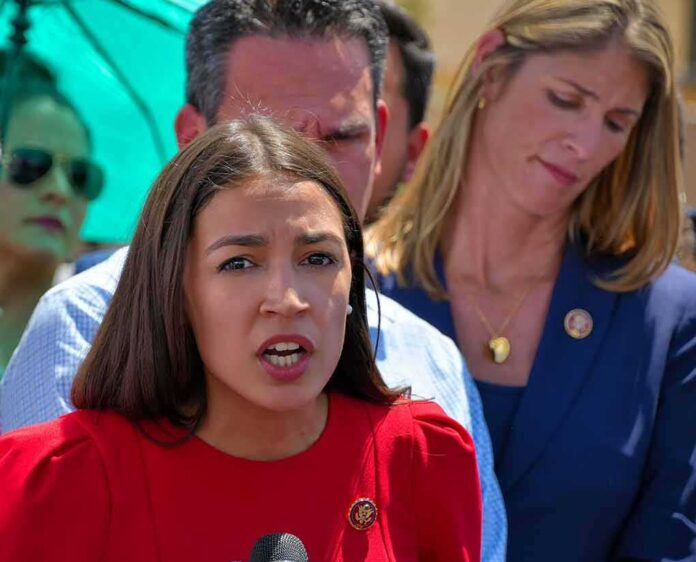
Alexandria Ocasio-Cortez said the Trump administration “doesn’t want women to go to college,” and the fight over what a loan rule really does now defines the debate.
Story Snapshot
- AOC tied a new loan-eligibility rule to women’s access to college.
- The Education Department says the rule targets low-earning programs, not women.
- Programs can lose federal loans after repeated earnings-test failures, with appeals.
- Dispute turns on intent versus impact in female-dominated fields.
What AOC Said, Where She Said It, And Why It Landed
Rep. Alexandria Ocasio-Cortez told a Michigan town hall on October 15 that the administration was “attacking women’s ability to get an education” and closed with, “They don’t want women to go to college.” She cited a Department of Education earnings test that could cut federal student loans for programs that fall short. She pointed to nursing, teaching, and social work as targets. Her charge carries heat because many students in those fields are women.
The instant clip traveled fast because it simplifies a complex policy into a moral headline. The framing is sharp: if loans dry up for programs that women choose, then women lose access. That claim hinges on two steps. First, that many of those programs would actually fail the test. Second, that students lack other ways to pay or switch tracks. The first step is uncertain without program-by-program numbers; the second depends on each school and student.
What The Rule Actually Does And How It Bites
The Department of Education finalized an earnings accountability rule that sets a test for programs. Undergraduate programs must show graduates earn more than typical high school graduates. Graduate programs must show earnings above typical bachelor’s degree holders. A program that fails the test in two of three straight years can lose access to federal Direct Loans. Schools can appeal. The department says the rule is about outcomes, not gender or professions.
The department also pushed back on claims of a ban. Officials said the government does not ban majors or set curricula. They argue the policy holds colleges accountable when students end up worse off than if they had not enrolled. They called the allegation that the rule aims to keep women out of college “fake news.” That is a clear, named rebuttal on intent. On projected impact, the department cited an estimate that 5.5 percent of women on aid would attend programs expected to fail.
Does This Hit Women Harder, And Is That The Point?
Women complete college at higher rates and hold most student debt, so any broad loan rule will touch many women. AOC’s point leans on fields with many female students, like nursing and social work. But the rule, as written, judges programs on earnings, not gender. That aligns with a classic conservative view: measure results, protect taxpayers, and stop funding programs that do not pay off in the job market. Intent claims need proof beyond correlation.
The key question splits in two. Could the rule burden women more in practice? Possibly, if many women enroll in programs that repeatedly fail the test. Was the rule designed to keep women out? The record does not show that. The Education Department’s documents stress legal mandates and earnings thresholds. The clean fix for fairness is sunlight: publish program-level outcomes and let students choose. Accountability should reward strong nursing and teaching programs and expose weak ones.
What To Watch Next: Programs, Not Punchlines
Program lists will decide the story. If reputable nursing or teaching programs start failing in large numbers, the access critique will gain force. If failures cluster in thin-value programs with poor placement and high dropout rates, the accountability case will look stronger. Voters should demand three things: public scorecards for every program, fast appeals for data errors, and clear off-ramps that let students transfer credits without losing time or money.
Common sense says tell the truth about outcomes and stop trapping students in debt. That is not anti-woman; that is pro-transparency. If a program produces solid jobs, it will pass and keep loan access. If a program fails twice, the burden should fall on the school, not the student. The loudest line from the rally will fade. The data will not. Follow the numbers, program by program, and insist every dollar lifts a life, not just funds a brochure.
Sources:
thegatewaypundit.com, washingtonexaminer.com, yahoo.com, knewz.com, x.com, ed.gov
© standardheadlines.com 2026. All rights reserved.